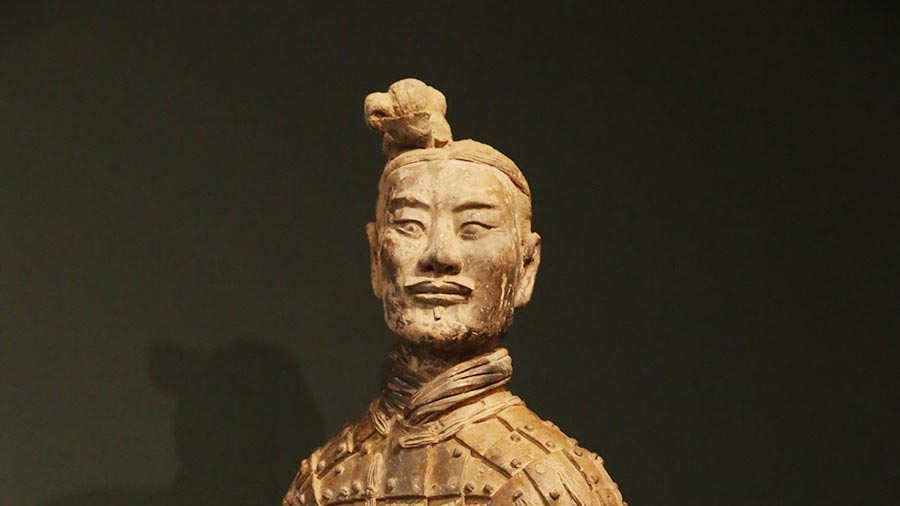
Qin and Han Dynasties
Overview
The Qin and Han Dynasties represent a significant era in Chinese history, marked by substantial developments in politics, economy, art, and culture. Spanning from 221 BC to AD 220, these dynasties laid the foundation for what would become a unified China, influencing its governance, culture, and social structures for millennia.
Political Contributions
The Qin Dynasty, though short-lived from 221 to 206 BC, was pivotal in unifying China under a centralized imperial government. It established the first bureaucratic empire, implementing standardized laws, currencies, weights, and measures. Qin Shihuang, the first emperor, is renowned for his role in the construction of the Great Wall and the Terracotta Warriors, symbolizing both his power and the military strength of the Qin state.
The Han Dynasty, extending from 206 BC to AD 220, continued and expanded upon the Qin's foundations, solidifying the structures of centralized governance. The Han era is notable for the establishment of the Silk Road, a trade network that linked China with the West, fostering economic and cultural exchanges. The dynasty also saw the development of the civil service system, promoting bureaucratic administration based on merit rather than aristocratic lineage.
Economic Achievements
Economically, the Qin Dynasty initiated large-scale public works that included the construction of roads and irrigation systems, which facilitated trade and agricultural productivity. The Han Dynasty further enhanced economic stability and growth, underpinned by agricultural advances, the expansion of trade routes, and the promotion of commerce. The Silk Road, established during the Han period, became a crucial artery for trade, linking China with Central Asia, the Middle East, and even Europe, spreading Chinese goods, technologies, and culture far beyond its borders.
Cultural and Artistic Influence
Culturally, the Qin and Han Dynasties were periods of significant artistic development. The Qin Dynasty is best known for the Terracotta Army, an extensive collection of sculptures depicting the armies of Qin Shihuang, serving as a testament to the artistic and technological prowess of the time.
The Han Dynasty is celebrated for its advancements in literature, philosophy, and the arts. Confucianism was established as the state philosophy, influencing Chinese cultural and ethical standards. Han art and literature flourished, with innovations in poetry, historical writing, and the visual arts. Han ceramics, paintings, and music reflect the sophisticated tastes and cultural achievements of the period.
Technological and Scientific Progress
Technologically, the Han Dynasty made significant contributions in various fields. It is credited with the invention of paper, which revolutionized communication and record-keeping. Other technological advances include improvements in metallurgy, with the use of iron becoming widespread, and innovations in agriculture, such as the chain pump and plow improvements.
The Han era also saw developments in astronomy and medicine. The period's scientific achievements were documented in texts like the "Nine Chapters on the Mathematical Art" and the "Yellow Emperor's Inner Canon," laying the groundwork for future advancements in Chinese science and medicine.
Archaeological Discoveries
Archaeological findings from this era, such as the Terracotta Warriors, jade burial suits, and intricate bronze artifacts, offer insights into the technological and artistic capabilities of the Qin and Han periods. Recent excavations have uncovered additional relics, including ancient maps and writings on bamboo slips, further illustrating the sophistication of Han society in terms of administration, knowledge, and culture.
Legacy and Influence
The legacy of the Qin and Han Dynasties is profoundly embedded in the cultural and historical fabric of China. They established the structural and ideological foundations of the Chinese imperial system, influencing subsequent dynasties for centuries. The unification and standardization efforts of the Qin, along with the Han's cultural and economic accomplishments, have left an indelible mark on China's historical trajectory, making this period a defining chapter in the story of Chinese civilization. Article reference1. 'Overseas shipping' treasures from 2,000 years ago. chinadaily.com.cn. 20242. Artifacts from the Hubei Provincial Museum illustrate local history and culture. chinaservicesinfo.com. 20243. A focus on the formative. chinadaily.com.cn. 20244. Casting light into the shadows of the past. chinadaily.com.cn. 2024Photo Gallery(7 pictures)CategoriesHistoryTagAncient Chinese HistoryHistorical FiguresRelatedWuwangdun SiteHistory of Chinese TeaTomb of the Nanyue KingBamboo SlipsCatalogue1. Overview2. Political Contributions3. Economic Achievements4. Cultural and Artistic Influence5. Technological and Scientific Progress6. Archaeological Discoveries7. Legacy and Influence- - - []








